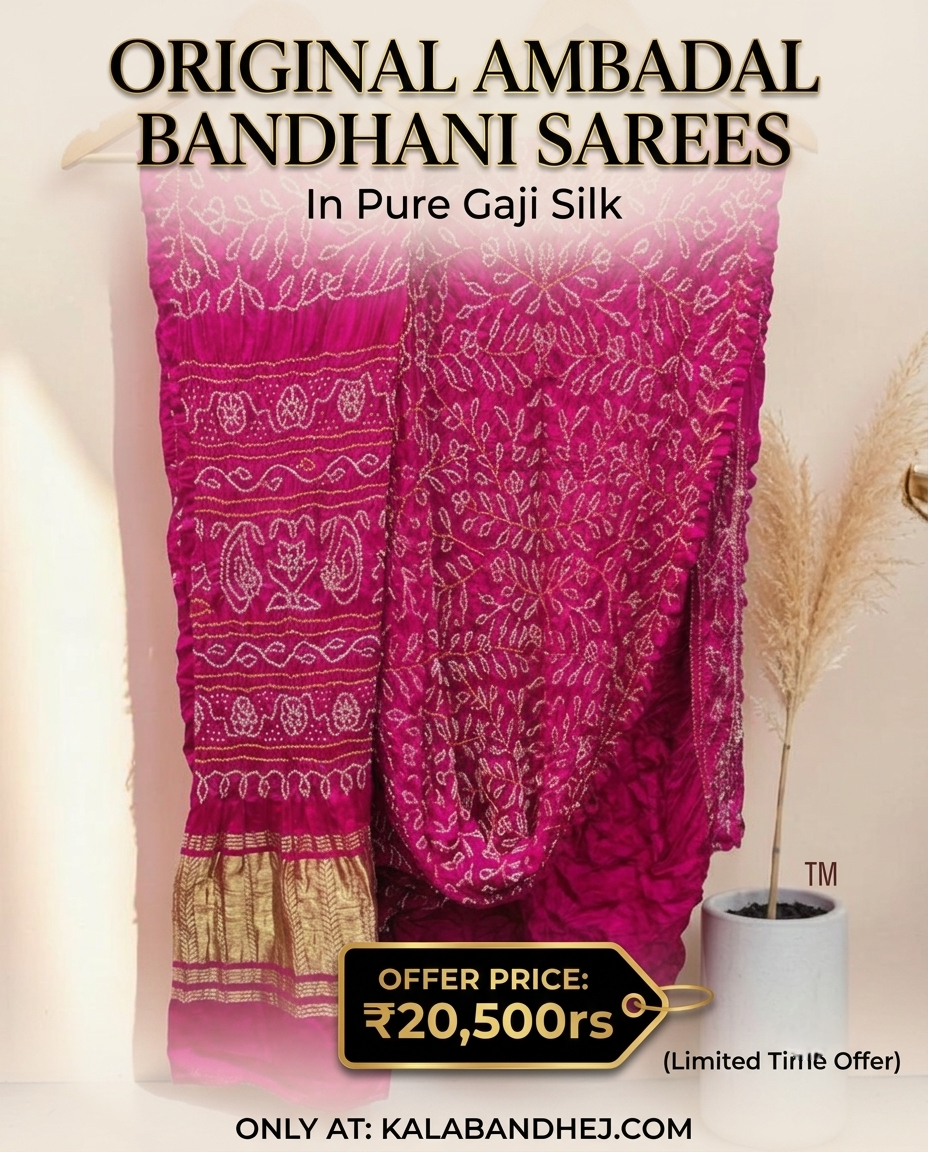
Celebrate timeless Indian craftsmanship with our exclusive collection of Ambadal Bandhani Sarees. Hand-tied by master artisans from Kutch, our collection brings you the intricate floral and mango-branch Ambadal motifs crafted on premium fabrics—available now at Flat 50% OFF. Enjoy complimentary color customization on select pieces to make your drape truly unique.
The Timeless Allure of Ambadal Bandhani Sarees
The Ambadal design is one of the most prestigious, labor-intensive motifs in the world of authentic tie-dye. Representing blooming branches, traditional paisleys, and dense floral grids, each Ambadal saree features thousands of micro-knot Rai Bandhani dots meticulously tied by hand. At Kalabandhej, we bring this heritage directly from our workshops to your wardrobe, offering unmatched authenticity and craftsmanship.
Explore Handloom Ambadal Sarees Across Premium Fabrics
Pure Gaji Silk Ambadal Sarees: Renowned for their rich sheen, heavy drape, and bridal grandeur, our Gaji Silk Ambadal sarees are the ultimate choice for weddings, trousseaus, and milestone celebrations.
Modal Silk Ambadal Sarees: Soft, breathable, and gracefully lightweight, Modal Silk offers a contemporary drape with a lustrous finish, ideal for festive gatherings and evening events.
Georgette Silk Ambadal Sarees: Flowing and easy to carry, our Georgette Bandhani sarees combine delicate Ambadal patterns with effortless modern elegance.
Why Buy Ambadal Sarees from Kalabandhej?
Feature
What You Get at Kalabandhej
Authenticity
100% genuine handcrafted Rai Bandhani directly from artisan clusters in Kutch.
Fabric Variety
Pure Gaji Silk, Modal Silk, and Pure Georgette Silk.
Free Customization
Pick your dream bridal or festive color shade at no extra charge.
Limited Time Offer
Flat 50% OFF across our entire curated Ambadal saree range.
Blouse Included
Every saree comes with an unstitched, matching designer blouse piece.
Caring for Your Handloom Bandhani
To preserve the natural sheen of Gaji silk and the fine texture of hand-tied Rai knots, always opt for professional dry cleaning. Store your sarees wrapped in breathable cotton or muslin bags away from direct moisture.
The Royal Legacy of Ambadal: History, Craft, and the Elegance of Handcrafted Bandhani Sarees
For centuries, Indian textiles have woven together folklore, royal patronage, and sublime craftsmanship. Among the revered heritage weaves of Gujarat and Rajasthan, the Ambadal Bandhani Saree holds a place of distinction. Known for its breathtaking complexity and regal aesthetic, the Ambadal design is not merely a pattern—it is a celebration of nature, precision, and tradition.
1. What is the Ambadal Design?
The name Ambadal translates poetically from traditional vernacular:
Amba refers to the mango (representing prosperity, fertility, and abundance).
Daal translates to the branch of a tree.
Together, the Ambadal motif portrays blooming mango branches, lush foliage, stylized paisley formations, and geometric borders hand-knotted onto fine fabric. Each leaf, curl, and branch is outlined using thousands of minute, tightly bound dots (Rai Bandhani), creating a dense, textured tapestry across the drape.
2. The History and Royal Origins of Ambadal Bandhani
The history of Bandhani dates back over 5,000 years, with earliest depictions found in the Ajanta cave paintings and texts from the era of King Harshachardhana. As tie-dye techniques evolved across Kutch and Saurashtra, royal courts began commissioning intricate compositions that mirrored the palaces, gardens, and royal emblems around them.
The Ambadal pattern became a staple among regal trousseaus during the Mughal and Rajput eras:
Symbolism: The mango tree has always symbolized auspicious beginnings, making Ambadal sarees essential for royal brides and festive ceremonies.
Patronage: Mastering an Ambadal layout required months of dedication by skilled artisan families, making these sarees heirloom possessions passed down through generations.
3. The Artistry: How an Ambadal Saree is Created
Creating an authentic Ambadal Bandhani saree is a labor-intensive, multi-step process:
Chhappai (Tracing the Grid): The complex Ambadal layout—featuring flowing branches, paisley medallions, and intricate pallu work—is imprinted onto the un-dyed fabric using washable, natural blue chalk.
Bandhai (The Tying Process): Master artisans use fingernails or a small brass ring (nakhlia) to pinch micro-dots of fabric, binding each one tightly with cotton thread. A single Ambadal saree can feature tens of thousands of individual knots.
Rangai (Dyeing): The fabric is dyed in traditional, vibrant colors. When the knots are unraveled, the resisted areas form the crisp, white-and-yellow Ambadal motifs against rich base tones.
4. Why Pure Gaji Silk Complements Ambadal
While Bandhani can be crafted on various textiles, pairing the Ambadal design with Pure Gaji Silk produces an unmatched drape:
Rich Luster: Gaji silk offers a subtle, luxurious sheen that highlights the textured Bandhani knots.
Durability: The high-twist, sturdy weave of genuine Gaji silk holds thousands of tight knots without tearing.
Bridal Grandeur: The weight and elegance of Gaji silk make it the quintessential choice for bridal sarees, festive pujas, and wedding trousseaus.
5. Discover Authentic Ambadal Sarees at Kalabandhej
Finding an authentic, master-crafted Ambadal saree requires direct access to genuine artisanal workshops. Whether you are looking for timeless bridal reds, regal greens, or contemporary pastel hues, explore the most extensive collection online.
From traditional Rai Bandhani knotting to complimentary color customizations, each piece is handcrafted to become your family’s next cherished handloom.
In the vast kaleidoscope of Indian handloom textiles, few crafts captivate the eye like Bandhani—the ancient art of resist tie-dyeing practiced for centuries across Gujarat and Rajasthan. While traditional dot motifs (such as Ekdali, Trikunti, or Rai Bandhej) are widely recognized, connoisseurs of heritage weaves hold a special reverence for the extraordinary Makdi Bandhani design.
1. What is the Makdi Design in Bandhani?
The word ‘Makdi’ translates to spider in Hindi and Gujarati. In textile craft, the Makdi design refers to a complex, fine radial pattern resembling a delicate spider’s web or an intricate starburst.
Unlike basic scattered dots, an authentic Makdi motif requires artisans to tie hundreds of microscopic knots in radiating concentric rings or delicate diamond grids. When dyed and untied, these masterfully spaced tie points create mesmerizing spider-web-like geometry that radiates across the body and pallu of the saree, providing striking visual depth and fluid movement.
2. The Labor of Love: How a Makdi Saree is Created
Creating a Pure Modal Silk Makdi Bandhani Saree is an exhaustive, multi-stage artisanal process that requires months of meticulous craftsmanship:
Fabric Selection: Artisans choose premium base fabrics like 100% Pure Modal Silk or Gaji Silk, known for their butter-soft texture, natural sheen, and fluid drape.
Drafting & Tracing: The radial spider-web pattern is painstakingly hand-traced on the untreated white fabric using natural, washable dyes.
Hand-Tying (Bandhan): Skilled women artisans use their fingernails and specialized threads to pinch and tie microscopic points along the traced grid. A single Makdi saree can feature tens of thousands of individual hand-tied knots!
Resist Dyeing: The tied fabric undergoes multiple dips in vibrant, non-fading dyes. The tied threads prevent dye penetration, leaving crisp, un-dyed contrast dots once released.
Washing & Finishing: The fabric is washed, steam-finished, and carefully stretched to reveal the breathtaking spider-web motif in full glory.
3. Why Choose Pure Modal Silk for Makdi Bandhani?
Butter-Soft Comfort: Modal Silk is a bio-based natural fabric offering the rich lustre of mulberry silk with lightweight breathability.
Vibrant Color Retention: Absorbs deep heritage dyes (crimsons, cerulean blues, yellow, and rama greens) without fading.
Wrinkle-Resistant & Easy Drape: Falls effortlessly around the body, holding pleats structured and crisp for hours.
4. Styling Tips for Your Makdi Bandhani Saree
Jewelry: Pair with antique Kundan, traditional temple gold, or oxidized silver jewelry to highlight the vintage Gujarati heritage.
Blouse: Use the matching 6.5m Bandhani blouse piece included with the saree, or style with a contrasting raw silk blouse with elbow sleeves for a regal modern look.
Occasion: Ideal for weddings, Sangeet functions, Pujas, festive family gatherings, and grand receptions.
5. Shop Authentic Makdi Sarees at Kala Bandhej
If you are looking to add an authentic piece of Kutch artisan heritage to your wardrobe, look no further than Kala Bandhej. Direct from master artisans, Kala Bandhej offers authentic Pure Modal Silk Dual Makdi Bandhani Sarees featuring:
When it comes to traditional Indian ethnic wear, few garments command the royal presence and cultural heritage of a Pure Gaji Silk Bandhani Saree. Originating from the artisan heartlands of Kutch and Gujarat, Gaji Silk stands out as the crown jewel of silk weave—celebrated for its rich satin luster, heavy drape, and deep-dyed hues.
Whether you are preparing for a grand wedding, a festive celebration, or looking to invest in a heirloom piece, Gaji Silk offer an unmatched blend of tradition and opulence.
In this comprehensive guide, we explore what makes Gaji Silk special, popular styles like Gharchola and Rai Bandhani, and how you can shop authentic hand-dyed designs at flat discounts.
What is Gaji Silk?
Gaji Silk is a pure, high-density silk weave with a natural satin sheen on the surface and a soft cotton-like texture on the inside. Because of its weight and tensile strength, Gaji Silk is uniquely suited for Bandhani (tie-dye) and Gota Patti work.
Unlike lighter silk fabrics that can tear under intricate tying, Gaji Silk withstands hundreds of tight knots (tupkis) required for authentic Kutch Bandhani without losing its elasticity or shine.
Key Features of Pure Gaji Silk:
High-Luster Finish: A subtle satin sheen that catches light beautifully during evening events.
Graceful Fall: Heavier than georgette or chiffon, giving it an elegant, structured drape.
Deep Color Retention: Absorbs natural vegetable dyes and rich pigments for long-lasting vibrancy.
Popular Gaji Silk Saree Varieties
When browsing through authentic collections, you will encounter several iconic styles:
1. Gharchola Gaji Silk Sarees
A cornerstone of Gujarati wedding traditions, the Gharchola features a distinct grid/check pattern woven with zari threads. Within each square block, skilled artisans tie intricate Bandhani motifs such as elephants, peacocks, or floral patterns.
2. Rai Bandhani & Bhrti Sarees
Rai Bandhani: Characterized by extremely fine, mustard-seed-sized tie-dye dots. Creating a single Rai Bandhani Gaji Silk saree can take months of meticulous handwork.
Bhrti Saree: Heavy all-over Bandhani work where almost the entire surface of the saree is filled with intricate tie-dye patterns.
3. Lagdi Palav Sarees
Featuring rich woven metallic zari borders (Lagdi Palav), these sarees blend smooth solid or shaded Gaji silk bodies with ornate traditional borders—ideal for festive receptions and bridal trousseaus.
Why Buy Authentic Bandhani From Kala Bandhej?
At Kala Bandhej, based in Bhuj, Kutch—the birthland of traditional Bandhani craft—every saree tells a story of heritage craftsmanship. Working directly with local weavers and master dyers ensures that every piece is 100% authentic pure Gaji Silk.
Advantage
What You Get at Kala Bandhej
Craft Authenticity
Directly sourced from traditional artisans in Kutch
Fabric Guarantee
100% Pure Gaji Silk with premium luster and weight
Exclusive Offers
Up to 50% OFF on selected Gaji Silk collections
Global Reach
Secure worldwide delivery directly to your doorstep
How to Care for Your Gaji Silk Saree
Dry Clean Only: To maintain the vibrancy of hand-dyed pigments and delicate zari work, always dry clean your saree.
Proper Storage: Store in a breathable cotton saree bag inside a dark, dry space. Avoid hanging for long periods to prevent stretching.
Ironing: Always iron on the reverse side using low to medium heat, or use a steam iron.
Shop Pure Gaji Silk Sarees Online
Looking to add a rich Gaji Silk Bandhani saree to your collection? Explore over 250+ handcrafted designs including Gharchola, Rai Bandhani, multi-color shaded, and Lagdi Palav styles.
The Gharchola Dupatta holds a sacred and timeless position in Indian heritage wear. Derived from the words “Ghar” (home) and “Chola” (attire), the Gharchola represents the quintessential garment draped over a bride as she steps into her new home with warmth and blessings. Recognized instantly by its iconic Zari Chowka (golden grid pattern), this drape has transcended bridal rituals to become an essential luxury statement for grand celebrations, festive pujas, and heirloom wardrobe collections.
When it comes to sourcing authentic, hand-crafted artisan textiles, Kalabandhej stands as India’s premier brand. Created directly by traditional Khatri artisans of Kutch, Kalabandhej blends centuries-old craftsmanship with modern color palettes to bring you the finest Gharchola collection.
🏛️ The Anatomy of an Authentic Gharchola
Traditionally woven in 12-section grid patterns known as Bar Bagh (12 gardens) or 52-section patterns known as Bavan Bagh (52 gardens), an authentic Gharchola is defined by its architectural symmetry. Within each zari-woven square, master artisans fill intricate motifs such as peacocks, lotuses, elephants, and hand-tied dot work.
At Kalabandhej, every piece is rendered on 100% Pure Gaji Silk, providing a lustrous sheen, rich texture, and a graceful flow that elevates any ethnic suit or lehenga.
🎨 Exploring the 3 Popular Gharchola Styles at Kalabandhej
1. Bandhani Gharchola Dupatta (The Timeless Classic)
The signature Bandhani Gharchola Dupatta combines gold zari check weaving with micro-knot tie-dye art (Rai Bandhani). Skilled Kutchi craftswomen tie thousands of tiny cloth knots using cotton thread before dipping the fabric into vibrant natural and rich dyes.
Best For: Gujarati & Rajasthani bridal drapes, Ghar ki Shaadi, festive pujas.
Signature Touch: Fine Rai Bandhej dots filling every single square.
2. Banarasi Gharchola Dupatta (Royal Fusion)
Bringing together the opulent handloom heritage of Varanasi with the tie-dye brilliance of Gujarat and Rajasthan, the Banarasi Gharchola Dupatta features heavy Kadwa or Cutwork zari borders and dense brocade gridlines.
Best For: Sangeet ceremonies, grand receptions, and pairing with solid raw silk suits.
Signature Touch: Luxurious gold or silver (Neemzari) brocade weaving along the entire length.
For lovers of artistic heritage, the Ajrakh Gharchola Dupatta fuses ancient 16-step natural block printing from Kutch with traditional Gharchola layouts. Using natural mineral and vegetable dyes—like indigo, madder root, and pomegranate peel—artisans block-print geometric and floral motifs directly into the gridwork.
Best For: Intimate weddings, festive gatherings, and bohemian-chic saree/suit draping.
Signature Touch: Earthy, organic hues and deep indigo-madder tones printed on pure Gaji silk.
📊 Comparing Gharchola Varieties at a Glance
Gharchola Style
Primary Technique
Fabric Base
Visual Appeal
Best Paired With
Bandhani Gharchola
Micro Tie-Dye (Rai Bandhej)
Pure Gaji Silk / Georgette
Vibrant, traditional, dot-matrix patterns
Bridal Lehengas & Silk Kurtis
Banarasi Gharchola
Zari Brocade Weaving + Bandhej
Heavy Georgette / Khaddi Silk
Regal, glossy, heavy zari borders
Anarkalis & Raw Silk Suits
Ajrakh Gharchola
Hand Block Printing with Natural Dyes
Gaji Silk
Earthy, intricate, heritage geometric art
Linen, Silk, & Handloom Outfits
🌟 Why Kalabandhej is the #1 Destination for Gharchola Dupattas
When buying a heritage textile online, authenticity and purity are paramount. Kalabandhej has earned its reputation as the most trusted brand for Gharchola dupattas due to its uncompromising craftsmanship:
Direct Khatri Artisan Craftsmanship: Made directly in Kutch, preserving authentic generations-old techniques.
100% Pure Gaji Silk Assurance: Lightweight, resilient, and naturally lustrous premium silk.
Free Color Customization: Need a specific bridal shade or matching palette? Kalabandhej offers complimentary color customization upon request.
Extensive Variety: From classic red and maroon bridal hues to modern ombre pastels, teal greens, and royal blues.
👑 How to Style Your Gharchola Dupatta
The Classic Bridal Double-Drape: Pair a heavy bridal lehenga with your primary dupatta over the shoulder and drape a red Bandhani Gharchola Dupatta over your head for blessings.
The Regal Suit Upgrade: Turn a simple solid-colored silk Anarkali (in ivory, bottle green, or deep navy) into a showstopper by adding a heavy Banarasi Gharchola Dupatta.
The Saree Belted Drape: Pleat an Ajrakh Gharchola Dupatta over one shoulder across a neutral saree, and cinch it at the waist with an embroidered belt for a contemporary royal look.
🛒 Shop the Largest Original Collection Online
Don’t settle for mass-produced imitations when you can own an authentic piece of Kutch art. Explore our handcrafted collection of pure Gaji silk Gharchola dupattas directly from master weavers.
In the world of premium Indian textiles, a spectacular evolution is taking place. Modern ethnic wear connoisseurs are constantly searching for a fabric that marries the majestic grandeur of traditional art with the effortless comfort of contemporary fashion. Enter Pure Modal Silk—the fabric that has taken the luxury ethnic wear world by storm.
At Kalabandhej, we specialize in transforming this incredibly luxurious fabric into wearable masterpieces right from our workshop in Bhuj, Kutch. If you are looking to elevate your wardrobe with a statement piece that feels like a second skin, here is everything you need to know about our Modal Silk Dupattas.
What is Pure Modal Silk?
Pure Modal silk is a premium, natural plant-based textile crafted from high-quality beechwood tree cellulose, processed to mimic the finest qualities of traditional silk. The result is a highly sustainable, eco-friendly luxury fabric that offers a liquid-like drape, a delicate feather-light feel, and a beautiful natural sheen.
When our artisans combine this modern luxury fabric with centuries-old tie-dye heritage, it creates an unmatched combination of comfort and style.
Why a Modal Silk Dupatta is a Wardrobe Essential
If you haven’t added a handcrafted modal silk piece to your collection yet, here is why it stands out as the ultimate modern ethnic accessory:
1. Breathable, All-Weather Comfort
Unlike heavy traditional silks that can feel restrictive in warmer months, modal silk is highly breathable, moisture-wicking, and incredibly soft against the skin. It keeps you cool during summer day weddings and drapes beautifully under winter layers, making it a true year-round luxury.
2. Intricate Kutch Bandhani Artistry
At Kalabandhej, our specialty lies in authentic, hand-tied Kutch Bandhani. Modal silk possesses an incredible capacity for dye absorption. Whether it is our classic geometric patterns or the highly sought-after Chandrakhani Bandhani layout, the microscopic, hand-tied knots open up to reveal crisp, vibrant, and strikingly sharp contrasts that instantly elevate any look.
3. Effortless, Fluid Drape
Modal silk is celebrated for its wrinkle-resistant properties and fluid fall. A standard 2.5-metre length and 44-inch width dupatta provides a generous canvas for versatile styling, flowing elegantly without feeling bulky or stiff.
4. Complimentary Free Color Customization
Because we are passionate about bespoke luxury, we proudly offer free color customization across our premium modal silk collections. If you have a specific designer kurta, anarkali, or lehenga you want to match, our master dyers in Kutch will custom-tint your dupatta to the exact shade of your choice at no additional cost!
How to Style Your Modal Silk Dupatta
The Sophisticated Office-to-Festive Look: Pair a vividly dyed Chandrakhani Bandhani modal silk dupatta over a crisp, solid cotton or linen kurta set. The natural sheen of the modal silk instantly transitions your outfit from casual daytime elegance to evening festive glamour.
The Modern Fusion Cowl: Thanks to its fluid drape, you can style the dupatta as a chic neck cowl or an elegant stole over a contemporary fusion dress or jumpsuit.
The Classic Side-Shoulder Pleat: Neatly pleat the dupatta over one shoulder to let the intricate, hand-knotted borders and rich colors take center stage.
Experience Authentic Kutch Luxury for Less (Flat 50% Off!)
Every single dot on a Kalabandhej dupatta represents a painstaking knot tied by hand, preserving a beautiful traditional craft.
For a limited time, you can experience this authentic heritage luxury at an unbeatable price. Enjoy Flat 50% Off sitewide across our entire handcrafted collection. Give your ethnic wardrobe the premium upgrade it deserves.
👉 [Discover Our Pure Modal Silk Dupatta Collection Today at Kalabandhej.com!]
The Ultimate Guide to the Panetar Dupatta: Celebrating Royalty, Ritual, and Kutch Craftsmanship
When it comes to traditional Gujarati bridal couture and grand festive heirlooms, few garments carry the emotional weight and regal splendor of a Panetar Dupatta. Rooted deeply in the rich cultural soil of Gujarat, the Panetar is more than just a piece of fabric—it is a timeless symbol of identity, grace, and artisanal brilliance.
At Kalabandhej, we honor this grand textile heritage right from the heart of Kutch. If you are looking to embrace the classic allure of a premium, handcrafted Panetar for your special day or next big festival, here is everything you need to know about choosing the perfect masterpiece.
What is a Panetar Dupatta?
Historically, the Panetar is the traditional wedding attire gifted to a Gujarati bride by her maternal uncle (Mama). The defining characteristic of a true Panetar is its iconic and auspicious color palette: a pristine white or ivory body beautifully contrasted by rich red, deep maroon, or vibrant rani pink borders.
While traditionally worn as a full saree, modern fashion-forward brides and ethnic wear connoisseurs are heavily opting for the Panetar Dupatta. It offers incredible styling versatility, allowing you to pair a breath-taking heritage piece with contemporary lehengas, anarkalis, or raw silk suits.
Why Buy a Kalabandhej Handcrafted Panetar Dupatta?
In an era dominated by mass-produced digital screen prints, a true connoisseur knows that luxury lies in the texture of authentic craftsmanship. Every Panetar piece we create stands out for its unmatched quality:
1. The Luxury of Pure Gaji Silk & Modal Silk
The base fabric makes all the difference in how your outfit moves and catches the light.
Pure Gaji Silk: The absolute gold standard for bridal luxury. Gaji silk offers a heavy, royal, liquid-like drape and a high-luster satin sheen that photographs beautifully during late-night wedding pheras and reception lights.
Pure Modal Silk: A phenomenal choice for women who prioritize a lightweight, ultra-soft, and fluid drape without sacrificing a rich, premium texture.
2. Intricate ‘Dhingli’ Doll & Traditional Motifs
Our signature collections elevate standard geometric patterns into wearable art. We specialize in intricate Dhingli (Doll) design motifs. Our master artisans in Bhuj spend weeks painstakingly tying microscopic, tight Rai Bandhani (mustard seed-sized knots) to form these delightful, traditional figurative doll clusters along the borders and body.
3. Complimentary Free Color Customization
Because we are direct manufacturers based in Bhuj, Kutch, we believe your dream outfit shouldn’t require compromises. We proudly offer free color customization on our premium Panetar dupattas. Whether you need to match a very specific shade of a designer bridal lehenga or want to swap the traditional red border for a unique experimental hue, our artisans will custom-dye it to your exact preferences.
How to Style Your Panetar Dupatta for the Festive & Bridal Season
The Double-Dupatta Bridal Drape: The most trending look for modern brides. Wear your primary lehenga dupatta draped across your shoulder, and use a heavy Gaji Silk Panetar Dupatta as your elegant head veil (palla) to add traditional sanctity to your bridal entry.
The Minimalist Regal Suit Look: Let the craftsmanship do the talking. Pair a vibrant, hand-tied Panetar dupatta over a solid ivory, cream, or gold raw silk anarkali.
The Classic Gujarati Pleat: Pleat the dupatta neatly over your right shoulder, letting the stunning Lagdi Patta (woven gold tissue border) and Dhingli motifs showcase their full glory at the front.
Shop the Authentic Kutch Collection at Kalabandhej (Flat 50% Off!)
Investing in a hand-tied Bandhani dupatta means preserving a piece of dying Indian art. Every single knot on our fabric tells a story of an artisan’s dedication, keeping a centuries-old craft alive right here in Kutch.
For a limited time, enjoy Flat 50% Off sitewide on our exclusive collections. Give your heritage wardrobe the upgrade it deserves.
👉 [Explore Our Pure Gaji Silk Panetar Dupatta Collection Now at Kalabandhej.com!]
The Eternal Dance of Craft: Ras Mandal Designer Bandhani Dupattas at Kalabandhej
In the world of luxury heritage textiles, certain pieces do more than just complete an outfit—they tell a story of rhythm, folklore, and centuries of unyielding craftsmanship. Among the most coveted treasures in Indian ethnic wear is the Ras Mandal Bandhani Dupatta.
At Kalabandhej (kalabandhej.com), based in the historic artisan hub of Bhuj, Kutch, we have revived this legendary motif. By blending the fluid grace of the ancient Ras Leela folklore with the unmatched precision of premium Kutchi tie-dye, our designer collection redefines modern festive luxury.
If you want to invest in a true masterpiece of wearable art, here is everything you need to know about the significance, craftsmanship, and styling of the Ras Mandal Bandhani Dupatta.
What is the Ras Mandal Motif?
The term Ras Mandal translates to the circular space or orbit where Lord Krishna performs the cosmic dance (Ras Leela) with the Gopis. In textile design, this translates into an incredibly complex, circular layout:
The Centerpiece (Mandala): A spectacular, dense radial cluster of intricate bhindis (micro-dots) that represents the divine focal point.
The Narrative Border: Surrounding the center, master artisans painstakingly tie human forms (Gopis and Krishna in dancing postures), peacocks, elephants, and floral vines.
The Symphony of Dots: Creating human and animal figures purely through tiny, hand-knotted tie-dye dots requires an exceptional level of skill that only a handful of master craftsmen possess today.
The Craftsmanship Behind the Kalabandhej Collection
Every Ras Mandal dupatta on kalabandhej.com undergoes a rigorous, months-long creation process right here in Kutch.
1. The Canvas: Pure Gajji Silk & Fluid Georgette
A motif this grand requires a luxurious base. We use ultra-premium Gajji Silk—known for its rich, high-shine satin finish and structural weight—and pure, airy Georgette that offers a flawless, graceful drape.
2. High-Twist Hand-Tying (Bandhan)
Using fine, high-tensile threads, our artisans pinch and knot the fabric thousands of times to map out the dancing figures. The dots are pulled so tightly that they resist the dye, keeping the core colors perfectly sharp and pristine.
3. Layered Artisanal Dyeing
To achieve the striking contrast characteristic of high-end Bandhani, the fabric is dyed multiple times, moving meticulously from lighter hues (yellows and oranges) to deep, regal base tones (royal blues, forest greens, vermillion reds, and deep maroons).
4. The Designer Edge: Gota Patti & Zardozi
To transform these heritage pieces into contemporary bridal and festive statements, we frame the traditional layout with hand-done Gota Patti embroidery, delicate mirror-work, and shimmering Zardozi borders. The result is a perfect balance of texture, light, and history.
3 Ways to Style a Ras Mandal Bandhani Dupatta
Because a Ras Mandal dupatta features a narrative, circular design, the way you drape it can completely alter its visual impact.
1. The Royal Front-Spread (Cowl Drape)
Don’t hide the artwork. Pin the dupatta on one shoulder and let the rest drape across your chest in a deep, fluid cowl, securing the other end at your waist. This showcases the full circular Mandala and the dancing figures across your front—ideal for a luxury wedding outfit or a heavy festive lehenga.
2. The Contemporary Contrast
Pair a multi-colored, vivid red or emerald green Gajji Silk Ras Mandal dupatta with a completely minimalist, monochrome raw silk anarkali or short kaftan set. Let the dupatta rest cleanly over one shoulder, cascading down to full length. The contrast between modern minimalism and ancient complexity is incredibly striking.
3. The Gujarati Seedha Pallu Style
For a traditional, timeless look during festivals like Navratri or Diwali, drape the dupatta over your right shoulder from the back, letting the beautifully embroidered pallu hang forward across your torso. This highlights the heavy borders and geometric alignments beautifully.
Preserving Your Heritage Investment
An authentic hand-knotted Ras Mandal dupatta is an heirloom piece meant to be passed down through generations. To maintain its beauty:
Dry Clean Only: Chemical processing ensures the natural, rich dyes do not bleed and keeps the silk fibers strong.
Store Safely: Always wrap the dupatta in a breathable, soft cotton or muslin cloth. Avoid hanging it on metal hangers, which can stretch the silk weave.
Manage the Texture: The characteristic crinkle of a fresh Bandhani dupatta proves its authenticity. If you prefer to open up the pattern to see the figures clearly, have it professionally steam-ironed on low heat. Never apply a heavy dry iron directly at home.
Experience Luxury at Kalabandhej
Every thread tells a story of patience, culture, and absolute perfection. Discover our exclusive range of handcrafted sarees, luxury dresses, premium dupattas, and bespoke bridal wear.
Shop the authentic Ras Mandal Collection online at kalabandhej.com, or visit our flagship retail store to experience the textures in person:
Here is a high-SEO, high-converting blog post tailored for your site. It seamlessly blends the deep history of the craft with a compelling 50% Off Limited-Time Sale call-to-action to turn readers into buyers.
The Timeless Elegance of the Bandhani Saree: History, Artistry, and a Special Celebration
There is something profoundly magical about an authentic Bandhani Saree. It isn’t just a piece of luxury ethnic wear; it is a canvas of living history, a labor of love, and an enduring symbol of Indian heritage. The way the crinkled fabric drapes, the brilliant contrast of its hand-dyed colors, and the rhythmic precision of thousands of tiny dots make it a prized heirloom in every woman’s wardrobe.
At Kalabandhej, we have been dedicated to preserving this incredible craft since 1985. Today, we invite you to step into the rich history of this textile art and discover how you can bring home your own masterpiece at an exclusive, limited-time price.
⏳ Tracing the History: A Craft Ancient as Time
The word Bandhani stems from the Sanskrit root ‘Bandha’, meaning “to tie.” It is one of the oldest surface-ornamentation textile techniques known to humanity.
Ancient Footprints: Historical records trace the art of plucking and tying cloth back to the Indus Valley Civilization around 4000 B.C.
Royal & Sacred Art: Ancient Buddhist murals in the Ajanta Caves showcase women in beautiful tie-dyed garments. For centuries, across Gujarat and Rajasthan, specific colors and patterns have carried deep cultural meanings—like the red Gharchola gifted to brides as a symbol of auspicious beginnings, or the yellow Odhani celebrating motherhood.
When you wear a Kala Bandhej creation, you are walking in the footsteps of queens, royal courts, and generations of master artisans.
🧵 The Artistry: How a Kalabandhej Saree is Created
An authentic handcrafted Bandhani saree cannot be replicated by a machine. The process requires immense patience and specialized skill:
The Blueprint: Intricate geometric and floral designs are meticulously stenciled onto premium base fabrics like Pure Gaji Silk, Modal Silk, or fine Georgette.
The Knots (Bandhejs): Women artisans use their fingernails to pinch tiny sections of the fabric, tying them tightly with impermeable thread to form dots (Khombhis). A single luxury saree can feature tens of thousands of these individual knots.
The Dyeing: The tied fabric is dipped into brilliant dye baths. The knotted areas resist the color, keeping the original base shade intact. This process is often repeated multiple times for multi-colored masterworks.
📸 Inside the Kalabandhej Atelier: Our Collection
Every image from the Kalabandhej Collection highlights the distinct, rich texture that defines genuine hand-done art. Look closely at our signature pieces:
Our Pure Gaji Silk Bandhani Sarees: Known for their opulent, royal sheen and thick, luxurious weight, these sarees easily carry heavy Zari borders and elaborate wedding embellishments.
Our Banarasi Bandhani Fusion: Witness the breathtaking combination of fine, hand-tied Bandhani patterns laid over premium georgette fabric adorned with metallic Banarasi brocade weave.
🔥 Exclusive Celebration: 50% OFF Sitewide at Kalabandhej.com!
To honor the incredible artisans who keep this 6,000-year-old craft alive and to thank our global family of patrons, we are launching our biggest event of the season.
For a limited time, enjoy an incredible 50% OFF across our premier collections online. Whether you are looking for a majestic bridal Wedding Gaghra Choli, a timeless festive Panetar, or a luxury Gaji Silk Bandhani Saree online, your perfect heirloom is waiting.
Why Shop the Kalabandhej Sale?
100% Authentic Handcrafted Quality: No digital prints, no machine imitations—only genuine tie-and-dye heritage.
Worldwide Premium Shipping: Safely packed and delivered from our artisan hubs straight to your international doorstep.
Bespoke Customization: Need custom sizing or tailoring for your dream ensemble? Our team is ready to assist.
Mass-produced fashion fades, but a handcrafted masterpiece lasts forever.
Here is a high-SEO, beautifully formatted blog post tailored for your website. It turns your technical details into an engaging, story-driven article designed to rank on Google and drive traffic directly to your shop.
The Ultimate Guide to Bandhani: History, Craftsmanship, and Patterns
For generations, the mesmerizing world of Indian textiles has been defined by its vibrant colors and intricate geometric art. At the pinnacle of this heritage is Bandhani (also known as Bandhni or Bandhej). Derived from the Sanskrit words ‘Bandhna’ and ‘Bandha’, which literally translate to “to tie” or “tying”, this ancient resist-dyeing technique creates breathtaking circular patterns on fabric using impermeable threads.
If you have ever marveled at the sheer artistry of a crinkled, colorful tie-dye saree, you have witnessed the magic of authentic Bandhani. In this comprehensive guide, we delve into the history, process, and types of this timeless Indian craft.
⏳ How Old is the Bandhani Technique?
Bandhani is one of the oldest forms of textile surface ornamentation in human history.
The Indus Valley Civilization: The earliest historical footprints of this technique—where artisans carefully pick the cloth with their fingernails to tie it before dyeing—date back to 4000 B.C.
Ajanta Caves (6th Century): Breathtaking Buddhist wall paintings in the famous Ajanta Caves clearly depict figures wearing garments adorned with Bandhani patterns.
Alexander the Great: Texts from the era of Alexander’s conquests explicitly extol the beauty of Indian hand-dyed Bandhani textiles.
👗 What is Bandhani Used For?
Historically, women in rural regions used basic Bandhej techniques to inject bright, joyful colors into their everyday attire. Today, the global fashion industry has fallen in love with its distinct texture.
While it remains central to traditional Indian luxury wear like sarees, festive ghagras, dress materials, customized dupattas, regal shawls, and turbans, contemporary designers are increasingly utilizing Bandhani for modern western silhouettes, premium bed linen, luxury curtains, and elegant home upholstery.
👥 Who Produces Authentic Bandhani?
True Bandhani is an entirely hand-done textile art that relies heavily on a community-based, cottage-industry model. The labor is highly specialized and traditionally divided within families of master craftsmen:
The Tying (Women & Young Girls): The intricate work of plucking and tying the fabric with thread (sometimes over pre-traced stenciled designs) is meticulously carried out by skilled women artisans in specialized Bandhani clusters.
The Dyeing (The Men): Once securely tied, the fabric is handed over to the men of the family, who oversee the intense boiling, dyeing, re-tying, and re-dyeing processes.
Because it cannot be replicated identically by machines, every genuine piece is a completely unique work of art.
🎨 Which Dyes are Used?
Because Bandhani is a hand-done artisan craft, heavy industrial machinery and harsh chemicals are minimized.
Natural Origins: Originally, Bandhej was created exclusively with organic elements like Indigo, plant roots, vegetables, bark, and wild flowers.
Modern Practices: Today, a careful balance of natural and synthetic dyes is used
⚠️ Artisan Note: Because of the intensive, layered hand-dyeing processes involved, most authentic Bandhani fabrics will bleed slightly during their first few washes. This is a natural characteristic of the handcrafted process, not a defect!
🧵 What Kind of Base Fabric is Needed?
Not just any fabric can become a Bandhani masterpiece. The base material must possess two crucial qualities:
Resilience & Elasticity: It must endure extreme stretching, tightly bound knots, and multiple rounds of boiling dye without tearing or losing its structural integrity when the knots are finally unraveled.
High Absorbency: The fibers must easily pull and lock in deep, saturated hand-dyed colors.
🌟 Premium Varieties: Gaji Silk vs. Banarasi Bandhani
When browsing for luxury heirloom pieces, two premium variations stand completely unmatched:
1. Pure Gaji Silk Bandhani Sarees
While pure silk looks stunning, it lacks the raw tensile strength required to survive the violent pulling of the Bandhani tying process. To solve this, artisans use Gaji Silk—a magnificent poly-silk or cotton-silk blend fabric.
Gaji Silk is thick, highly lustrous, and remarkably smooth. It easily withstands heavy bridal embellishments like Zari borders and Zardozi embroidery, making it the absolute gold standard for Gujarati Gharcholas, Panetars, and spectacular Wedding Lehenga Cholis.
2. Banarasi Bandhani Sarees
When the finest weaving meets the finest dyeing, you get a Banarasi Bandhani. These exquisite creations utilize a premium, lightweight georgette base featuring opulent, metallic Banarasi brocade borders woven right into the fabric. The hand-tied Bandhani patterns layered onto these luxury sarees are often impossibly fine and intricate.
📐 Deciphering Types of Bandhani Patterns
The language of Bandhani is told through its dots and layouts. Artisans categorize the patterns based on the grouping of the knots:
Intricate circular designs appearing in groups of three
Chaubasi
Dots clustered beautifully in groups of four
Dungar Shahi
Elaborate geometric “mountain” layout formations
Leheriya
Striking, continuous wave-like diagonal stripes
By repeating these fundamental building blocks, master artisans create intricate narratives on cloth, illustrating detailed leaves, blooming trees, dancing figurines, and local flora.
🛍️ Looking to Buy Authentic, Handcrafted Bandhani?
At Kalabandhej, we have been preserving the legacy of traditional Indian textile arts since 1985. Every saree, lehenga, and dupatta in our catalog is handcrafted by real artisan families using the exact generational techniques detailed above.
Bring home a piece of living history today. Experience luxury that transcends time.